Read the back and the edge against the written specification, not from a photograph alone
On a hand-finished rug, turn the piece and read the back and the edge against the written specification and the approved sample. A photograph of the face, or the artwork for one of the 41 designs, does not by itself establish construction, backing or edge.
A reading table for the back and the edge
On a hand-finished rug, turn the piece and read the back and the edge against the written specification and the approved sample. A photograph of the face, or the artwork for one of the 41 designs, does not by itself establish construction, backing or edge.
This page thickens Reading a handcrafted rug in full and in detail; it does not replace it. Use it with the commission brief and the surface-family decision. Construction must be written into the specification. It is not inferred from artwork or from a photograph alone.
| What to look at | What it can help you read | What it cannot settle by itself | What must be written into the specification |
|---|---|---|---|
| The face, and the surface family | The face is where the three published surface families are read: carved and cut pile, loop and high-low texture, and shaped and sculptural. Those family pages are a way into the 41-design library; they are not a partition of the 41 designs. A carved line, a pile transition or a shaped outline should be judged from the doorway and from the seating, in daylight and evening light. | A photograph of the face records only one lighting condition. It does not establish fibre, construction, backing or edge, and a similar colour does not establish the same material. | Name the starting design if any, the fibre, the colour, and whether the surface should be read as carved or cut pile, as loop or high-low texture, or as a shaped and sculptural outline. Mixing two surface families on one piece is only valid if the written specification and approved sample say so. |
| The back | On the approved sample and on the finished piece, turn the rug and look at the back against the written record. The back should match the backing and construction that were written down. | This site does not publish a generic knot-count or machine-made identification method. The back of a photograph, or a photograph of the face, is not a construction record. Handmade, handcrafted and hand-finished are commission terms agreed design by design; they are not a claim that every commission is hand-knotted. | Backing and construction are separate specification fields from the surface finish. Relief carving and a high-low cut-loop finish describe aspects of the surface; the underlying construction and backing still have to be named. If the back does not match the agreed record, raise it in writing before the piece is accepted. |
| The edge | The edge is a separate decision from the field. Check that the edge treatment closes the outline as agreed — rectangular, shaped, octagonal, round or runner, or a custom outline — and that it sits against the floor as the brief required. | An artwork study or a catalogue photograph shows a direction for pattern and colour. It does not, by itself, establish how the edge is finished. | Record the outline and treat the edge as a separate decision from the field. Confirm the edge finish with the sample, together with finished dimensions. Catalogue reference sizes are starting figures, not stock and not the finished size. |
| The approved sample against the written record | The sample is the decision. A useful sample lets you read the face, turn the piece to the back, and check the edge, then compare all three with the brief. Later care questions should also be answered against the fibre, finish and setting of the individual piece. | A screen image, a drawing or a pattern study records a design direction. It does not, by itself, establish the fibre, construction or finish of the completed rug. | Keep the approved sample with the written specification. Record which sample was approved, and under which conditions. Production timing is confirmed for the individual order; this site does not state a standard period. |
The face, the back and the edge are separate readings
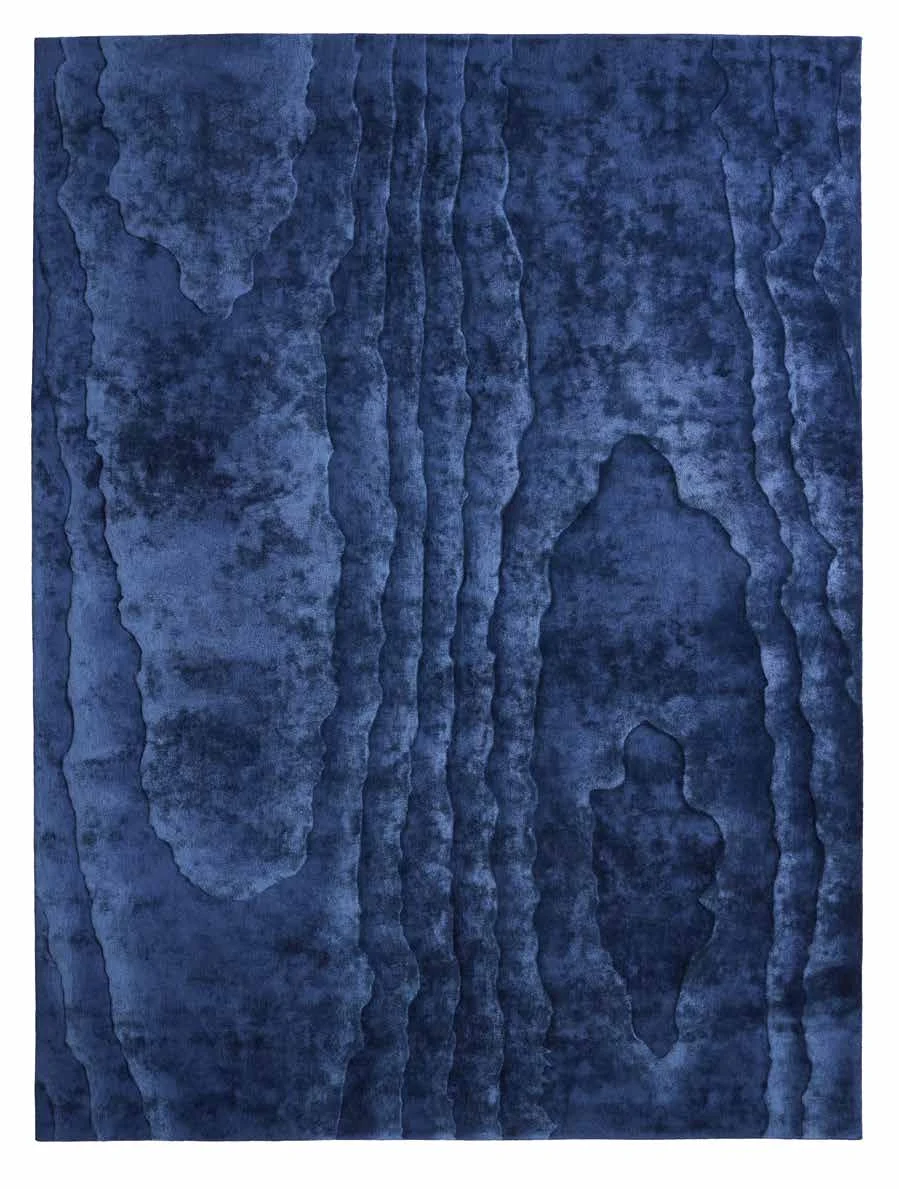
Paeonia, shown above, is a deep blue rectangular design in viscose, with relief carving and cut pile, and a catalogue reference of 300 × 400 cm. The image records the face of that design. It does not show the back or the edge, and it does not settle construction. The same limit applies to any of the 41 designs, including pieces whose surface is read as loop and high-low texture or as a shaped and sculptural outline.
Read the fibre and technique for the individual design. Viscose, wool, lyocell, silk and named blends appear in different combinations; a similar colour or surface treatment does not establish the same material or the same care requirements. The published workshop for this work is a hand-tufting workshop in Xiqiao, Nanhai, Foshan. Hand-tufted making is part of the studio’s public record here; it is not treated as a lesser or separate category from the handmade or hand-finished pieces in the collection.
What remains outside this page
This page is a reading note for the back and the edge of a handmade or hand-finished piece. It is not a living-room furniture size chart, and it is not a hotel mill specification. Readers sizing a movable rug around a sofa and table should use the furniture-group size note on adarug.com. Readers who need a wall-to-wall or mill specification for a hotel or workplace should use the hotel and workplace specification brief on adacarpet.com.
How to use this page with the brief
Once the face, the back and the edge have been read against the room, lock the remaining fields in the commission brief. If the surface family has not yet been chosen, read how to choose among carved pile, loop texture and sculptural surfaces first. Review a physical sample before production.
Email adafloor@163.com or call +86 158 1876 6066. Showrooms are in Shenzhen and Shanghai; visits are by appointment. The workshop is the hand-tufting workshop in Xiqiao, Nanhai, Foshan. Catalogue reference sizes remain starting figures, not stock.
Bring the plan, the preferred design and the questions about back and edge to the conversation.
Discuss a rug or carpet with ADA ↗